
Kaiju (Japanese: 怪獣 かいじゅう, Hepburn: kaijū; lit. 'strange beast'; Japanese pronunciation: [kai (d)ʑɯː]) is a Japanese term that is commonly associated with media involving giant monsters.
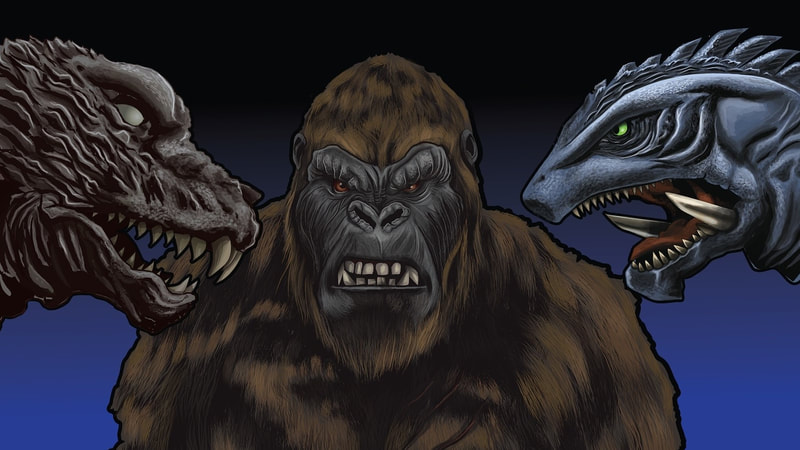
Traditionally, kaijū can refer to any sort of strange creature, but in recent times the word has become associated with a genre of tokusatsu entertainment, specifically Japanese cinema that involves giant monsters.
The term kaiju can refer to the giant monsters themselves, which are usually depicted attacking major cities and engaging the military, or other kaiju, in battle. The kaiju genre is a subgenre of tokusatsu (特撮, "special filming") entertainment.
Welcome to Kaiju Battle, a website that brings together news, info, and more for fans of kaiju like Godzilla, Gamera, King Kong, and films like Pacific Rim, and the Monsterverse, and more.
What is a Kaiju? In pure fan-terminology context, a kaijū is any creature that is significantly large in scale. Kaiju as a word also refers to the genre of media that includes these giant creatures. The origins of the term are hard to trace, and can be found in early Japanese literature and folklore.
For nearly seven decades, Godzilla and the other kaiju have kept audiences at the edge of their seats. Kaiju represent the larger-than-life dangers we face as humans, such as nuclear war and alien invasions, as well as the unstoppable power of nature itself.
Kaiju (怪獣 kaijū?) is a Japanese word that literally translates to "strange creature". However, the word kaiju has been translated and defined in English as "monster". Specifically, it is used to refer to a genre of tokusatsu entertainment.
Godzilla x Kong: Supernova is reportedly going to feature a major kaiju villain decades after its original appearance. Supernova is the next movie in Universal's MonsterVerse franchise, which includes both Godzilla and King Kong.
Kaiju (Japanese: 怪獣 (かいじゅう), Hepburn: kaijū; lit.'strange beast'; Japanese pronunciation:[kai (d)ʑɯː]) is a Japanese term that is commonly associated with media involving giant monsters.